Practical Car Camping Storage Tips for Couples
How do you even store everything, including a BED, into an SUV and then go travel comfortably?
Finding the right car camping storage strategy was SUPER important to me before traveling the USA for 2 years in my SUV.
And it was 2 of us living in that Forester!
We eventually got it right, but it took a while to create a real system.
Now, car camping is already stressful.
Add a mess and it can be unbearable – we don’t want that.
So, whether you’ve been car camping and need a better system, or are planning your first trip and need guidance, I’m writing this blog post to give you some useful budget tips to make your road trips easier!

Disclosure: This blog has affiliate links, and it’s how I can keep doing what I love. If you book something, I might make a commission with no added cost to you. Thanks for the support!
Why Car Camping Storage Gets Messy Fast (Especially for Couples)
I mean, it’s kind of obvious.
You’re trying to fit the things you need to survive AND a bed in a car:
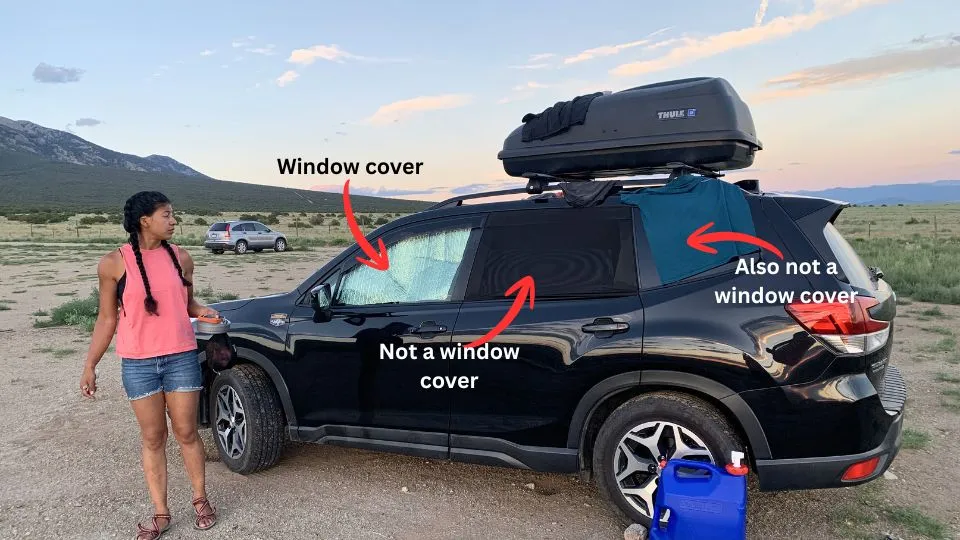
- Bed, bedding, and window covers
- Food for a few days and a whole kitchen setup
- Clothes and toiletries
- Car tools and safety equipment
- Gear for hiking/climbing/whatever it is you’re traveling for
- Car camping gear itself (like fans, generators, etc.)
And the more people and the longer you travel, the more things you need.
And don’t get me started on the dirt factor – dirty clothes, muddy shoes – everything is working against you to make your SUV messy.
It’s a lot to manage, and car camping storage gets messy the fastest when you let it snowball into something overwhelming.
That’s what you want to keep from happening.
The Simple Storage System that Worked in Our SUV
The secret to ideal car camping storage for maximum comfort is to create a system.
From here on out, I’ll share the system Lala and I created because it worked really well for us.
Feel free to copy it and adapt it to your lifestyle and needs!
Our system revolved around 3 categories of items:
- Stuff we used multiple times a day
- Stuff we used daily or at least pretty often
- Stuff we only used sometimes
Storing these things strategically helped lower our daily stress levels.
Stuff we Used Multiple Times a Day
We stored stuff we used several times every day somewhere easy to reach!
What stuff do you use every day while car camping?
I’m thinking things like all the kitchen gear and our water.
These things went in our trunk during the day and it the front seats at night (if you’re wondering why it changes, read about my entire sleeping set up).
Stuff we Used Pretty Often
The stuff we used daily or almost daily was close at hand but not quite as easy to reach as the stuff we used ALL the time.
What I mean is things like our computer bags (also nice to keep them sort of hidden), clothes, and car camping/car tools.
These went under our folded-down back seats.
Stuff we DIDN’T Use Every Day
We kept everything we didn’t use every day for car camping out of the way, like climbing gear, our ice scraper and hiking sticks.
We stored that stuff in the cargo box.
Real Life Example: Our SUV Camping Storage
That car camping storage system sounds good, but what does it actually look like?
Ok, the first thing to know is that we did NOT have a car camping platform – we didn’t need one.
That’s one car camping trend that is over-hyped. It actually makes storage annoying because everything HAS to get stored in bins under your bed.
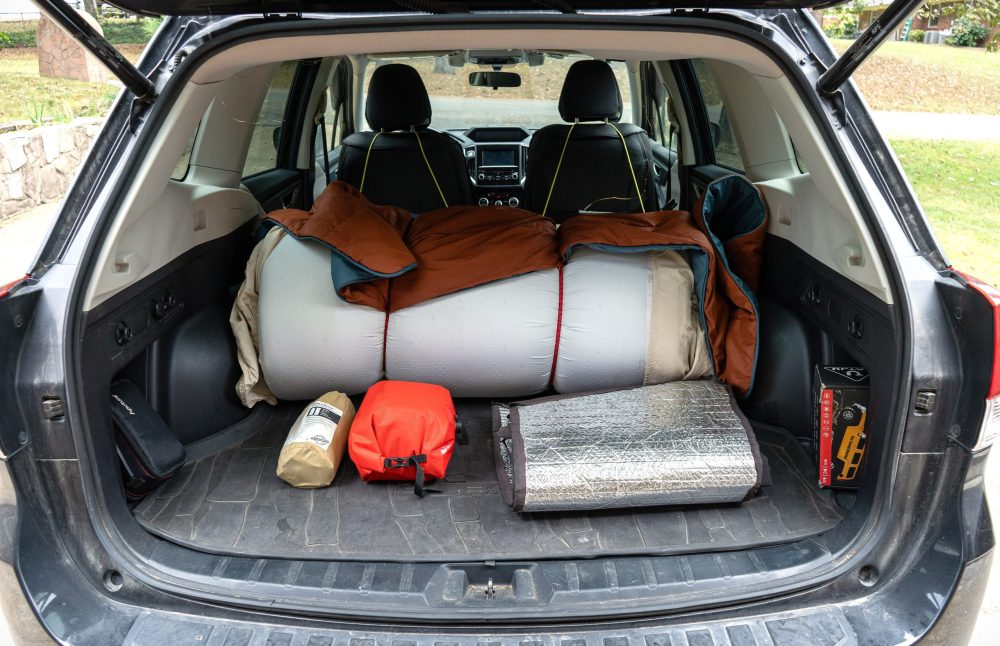
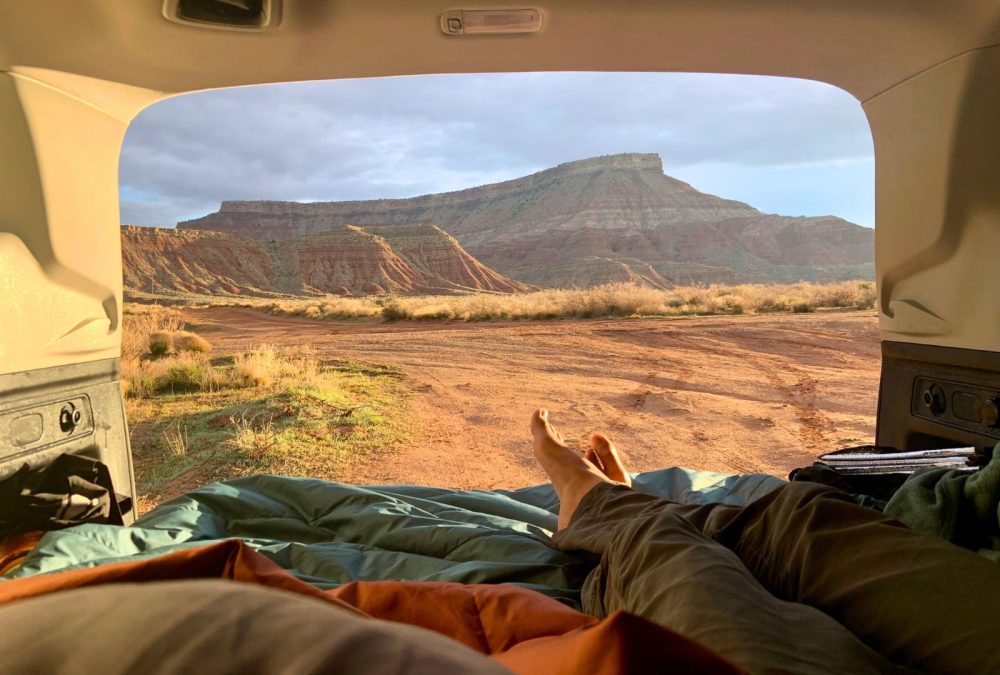
Our setup was much simpler: the bed went right on our flat SUV trunk, and we would fold it over the back seats during the day.
That way, the bed only took up the space over our back seats during the day.
Our storage spaces were: the entire trunk area, the space under the back seats, and the cargo box.
Then, at night, we made our bed and everything in the trunk went in the front seats.
With this system, everything has a home and you know where everything is (theoretically).
Practical Car Camping Storage Tips
Let’s go over some super practical, more specific car camping storage tips.
I’ll also share some of the mistakes we made along the way and how we solved some common problems.
1. Our Huge Mistake: Soft vs Hard Bins for Car Camping Storage
When we first started what became 2 years of car camping, our storage was MESSY.
We’re frugal, so we just used bags we already had, and that was not ideal.
Half our kitchen stuff when in a flimsy biking backpack and the other half went in a foldable rubber bucket.
Whatever didn’t fit in those two bags got stuffed into one of those durable Aldi grocery bags.
I don’t know how, but we kept this up for like 6 months!!
Then, we finally had a lightbulb moment and bought two hard plastic bins – they didn’t even cost must, like less than $20.
And it made a world of difference!
Somehow, organization can really affect your mental state.
The stress of a really bad system, like flimsy bags holding all your belongings, really adds up.
So, what did it look like after we got the bins?
2. Organizing Food Storage for Car Camping
Keep in mind – our car camping storage was very minimalist.
It’s part of how we road tripped across the USA for 2 years on such a small budget.
But, though it was minimalist, it was very structured.
We got two bins, and each one was for a specific type of thing:
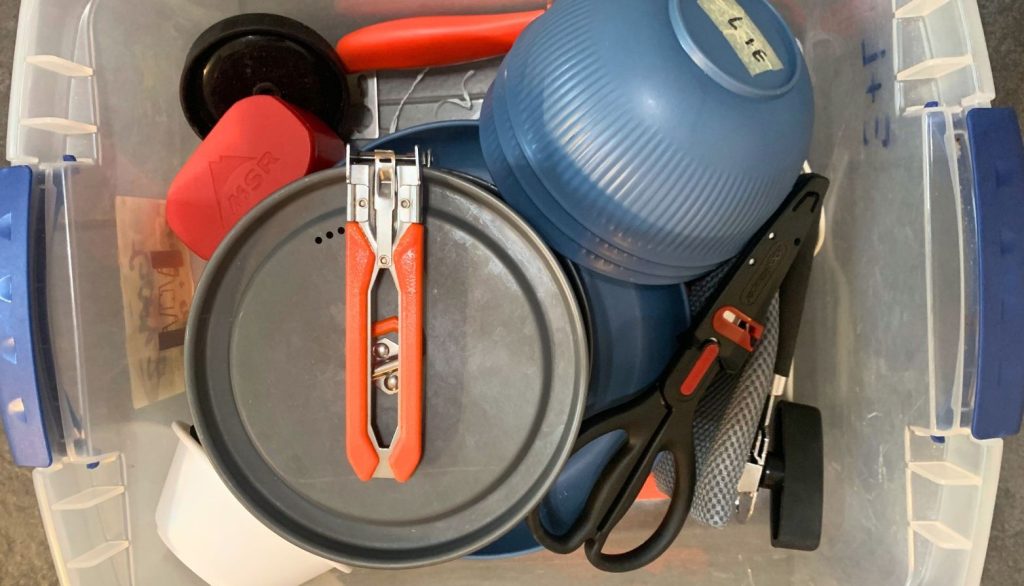
- The 15-quart bin: It held all our kitchen tools, like pots, bowls, plates, utensils, knife, pocket rocket, scissors, can opener, and more. It was pretty much everything in a small bin! If you’re wondering how in the world this was enough for us, read my blog post that’s all about our car camping kitchen.
- The 27-quart bin: This bin stored all our non-perishable food, like cans, rice, and meal prep stuff.
- Our tiny cooler: This is the one good storage method we got from the beginning. It’s an REI backpack cooler. The bottom of the bag is the cooler, and we kept 2 days of meat and other fresh food in there. The top of the bag is a drawstring bag where we kept a bunch of snacks.
- The Aldi bag: Yes, we continued using the Aldi bag. I mean, some bigger things like our 10-inch pan and gas cannisters didn’t fit well anywhere. So, the Aldi bag was actually perfect for that stuff.
- A 7-gallon water jug: At the start, we’d buy gallon-jugs of water and refill them wherever we could. About 8 months into living in our SUV, we finally bought a huge jug and it made storage and life so much easier.
All of these storage methods went side by side in our trunk and only took up half the space!
3. What Made it All Possible – Our Cargo Box
I cannot stress enough the importance of having a cargo box on top of your car.
While you could probably go car camping without one, I wouldn’t recommend it.
I’ve made storage seem simple in this blog post – just keep the essentials in your car!
And that’s only possible because the non-essentials get stored in the cargo box until they’re needed.
Otherwise, they’d be heaped up in your trunk.
We kept all our rock climbing and hiking gear, seasonal clothing and bedding, tripod, yoga mat, tent and more in our cargo box.
And, again, everything went in it’s own storage method (like climbing gear in a climbing bag), and we kept the cargo box organized so that things were easy-ish to access.
Tips on Getting the Right Cargo Box
- Don’t be afraid to mix brands: Every cargo box needs a roof rack, and don’t be afraid to get two different brands! It will mean you need to make sure they’ll be compatible, but sometimes mixing brands makes things less complicated and cheaper.
- Get a good cargo box: Thule is the best-known cargo box brand, but Yakima and Inno are great too. Any of these brands will work, but I’d be wary of other brands. Make sure they’re made of hard plastic and attach to your roof rack with metal accessories. I wouldn’t trust straps for long-term use.
- Invest: Cargo boxes can be expensive, but they are worth the price for how much they help relieve stress while car camping. Plus, they last forever!
- Be smart: Since they last forever, you might want to get a used cargo box! I got mine on Facebook Market. Just inspect it before paying for it to make sure it works well, and you’ll get a long-lasting piece of gear for a great price.
I got a Thule Sidekick, which is an old model they no longer make.
The most similar one you can get now is the Force 3 M.
It’s not that big, so it’s cheaper, but it’s more than big enough for a minimalist car camper. If you need more storage space, there are size L and XL options too!
Thule’s newer models are way more aerodynamic and won’t affect your MPG as much.
For a roof rack, I got the Malone AirFlow2 Universal System because I blew my budget on the cargo box.
And, although it was cheaper, it worked extremely well and was easy to setup.
It’s still on my car and will be for a long time!
4. Clothing Storage for Couples (for less fights)
It’s always smart to keep some things in a partnership separate.
The more touches there are in a relationship, the more opportunities there are for tension.
And with car camping, you have no privacy and you’re always in each other’s space.
When it comes to storage, clothing is something you should separate and each do your own way.
To do that, Lala and I stored our clothes in another 27-quart bin under the back seats.
But we stored them in packing cubes.
Lala had 3 and I had 2.
As for me, I packed my shirts, pants and shorts in a big packing cube and all my underwear and socks in another, smaller one.
I don’t even know how Lala organized hers, but it wasn’t my business!
5. What about the small stuff?
I’ve covered a lot of the essentials for car camping, but what about small things like cables, pencils, money, passports – stuff like that?
Well, it’ll be different for everyone.
But the idea remains the same: set up a system and keep it.
For example, we kept a small carry-one suitcase in our cargo box with our important documents like passports – good to know where those are for when you need them!
We had an electronics organizer for cables, chargers and other small electronics.
We always kept an “everything bag” between our front seats that was pretty much a bedside table for us.
Plus, we got good travel backpacks for all our work stuff (laptop, cables, etc.) – 1 for me and 1 for Lala.
And apart from having very strategic places to store small things, we tried to always keep storing them in the same place so that we could always find them.
6. Minimalist Car Camping Storage for Solo Travelers
I’ll be honest, after car camping as a couple for so long, solo car camping seems so easy now.
Especially when it comes to storage – you just have SO much space.
My solo car camping setup when I traveled all over the PNW was like this:
- Bed: I just slept on a 2-inch sleeping pad with a sleeping bag.
- Side of bed: At night, I moved everything that was in my trunk to the side of the car where I wasn’t sleeping and the front seats.
- During the day: during the day, I folded my sleeping pad and sleeping bag so it barely took any space. That means I had most of the car to store everything – way more than enough space.
And this solo car camping trip was during our 2 years of travel.
Lala was gone and I was alone, but most of her stuff was still in the car.
It was still easy because, again, it was one whole less person!
Still refining your car camping setup?
Read my complete SUV Camping Guide that applies to all SUV’s!
Common Car Camping Storage Mistakes (That Make Everything Harder)
Let’s go over some mistakes that make life car camping harder, and shed some light on some new ones:
- Trying to live normal life: Car camping isn’t normal life, and having less makes it better. If you try to live life normally, having belongings that make you feel good, you might actually end up disliking it more. At least, that’s what happened to me.
- Storing things in flimsy bags: Get yourself some good, solid plastic containers to structure your organization.
- Collecting junk: Always ask yourself, “Do I really need this?” “How often will I use it?”
- Lifestyle creep: Lifestyle creep usually has to do with spending more, but in this case it’s about collecting stuff. With time, you start accidentally getting more stuff. Then, all of a sudden, you’re cramped in your SUV. It happened to us, and all you have to do is notice the habit to set it straight!
- Not investing in the right tools: Getting cheap gear will make life harder. Go ahead and get stuff that makes you happy, even if it costs more! It might end up being cheaper in the long run because you won’t have to replace it for years.
- Getting a cheap cargo box: A friend we made during our travels had her cargo box fly off her car on a highway!! The fact nobody got hurt was a miracle. Get yourself a good cargo box you can be sure will stay on your car (my biggest fear) and will keep your stuff dry!
Frequently Asked Questions
First, organize everything in 3 categories: 1) stuff you use multiple times a day, 2) stuff you use often, and 3) stuff you don’t use much. The stuff you use a lot should be easy to access, while the stuff you don’t use as much can be stored out of the way, like in a cargo box.
Second, have an assigned bag, container or bin for everything, and a place for every bin. That way, you have a system and a structure, which makes it easy to always know where everything is.
It doesn’t matter what your system is, what matters is that you have a system that works for you!
This eases the stress of car camping and makes the whole journey more enjoyable.
Over 2 years of living in my car, I used different storage containers for different things. I love clear plastic bins for all my kitchen gear. And honestly, those bins can be useful for a lot more than just kitchen tools and food. I recommend getting a combination of 15-quart and 27-quart bins.
Other than those bins, we also used grocery bags for big and weirdly-shaped items. Plus, we used a small backpack cooler from REI for fresh food and snacks.
From my experience living in a Subaru Forester for 2 years, I kept my non-perishable food in one 27-quart plastic bin and my fresh food in an REI backpack cooler. With this combination, you can store a bunch of food for multiple days.
When it comes to fresh food, I would only buy 2 (max 3) days of fresh food and keep it in my small backpack cooler. I always bought frozen meat to not have to get ice – that way I could fit more food in the cooler.
This cooler also has a drawstring bag on top of it, where we kept bread and all our snacks.
And that’s where all our food went!
We ended up shopping about every 3-4 days because we liked eating fresh food as often as possible.
What I Actually Used for 2 Years of Car Camping (Links)
Here’s a comprehensive list of all the car camping storage essentials I talked about in this blog. There are more things, but they’re minor compared to these.
This list includes THE most important things that really gave our storage system structure.
Pro tip: The cargo box can be expensive, so you might want to look on Facebook Market too.
| – A size M cargo box (or L/XL) – Roof rack for cargo box – A small cooler – 7-gallon water jug – Hiking bags – Electronics bag – My work backpack | – Our “everything bag” – Packing cubes (for clothing) – Lala’s work backpack – Vacuum seal bags – 1-2 durable grocery bags (Aldi) – 27-quart bins – 15-quart bins |
If you keep your car camping storage minimalist, this is all you’ll need – and you could probably do it with even less!
Organized, strategic storage is absolutely essential for a good car camping experience.
So, don’t sleep on it, and create a good system for yourself!
That way, you’ll be able to go on budget road trips whenever you want without worrying about where things are.
If you thought this blog post was useful, consider joining my newsletter below. I share practical tips on going on affordable road trips in the USA!