7 Iconic Landmarks in Death Valley in 1 Day
Disclosure: This blog has affiliate links, and it’s how I can keep doing what I love. If you book something, I might make a commission with no added cost to you. Thanks for the support!
Death Valley is amazing. Period. It’s also the largest national park in the Lower 48. That means exploring it in 1 day is pretty hard. But fortunately, there’s a popular route you can take to see everything you need to see in Death Valley in 1 day.
The route covers the 7 most iconic landmarks in death valley. And the best part is they’re close to each other. You end up driving a total of an hour and a half in a very busy day.
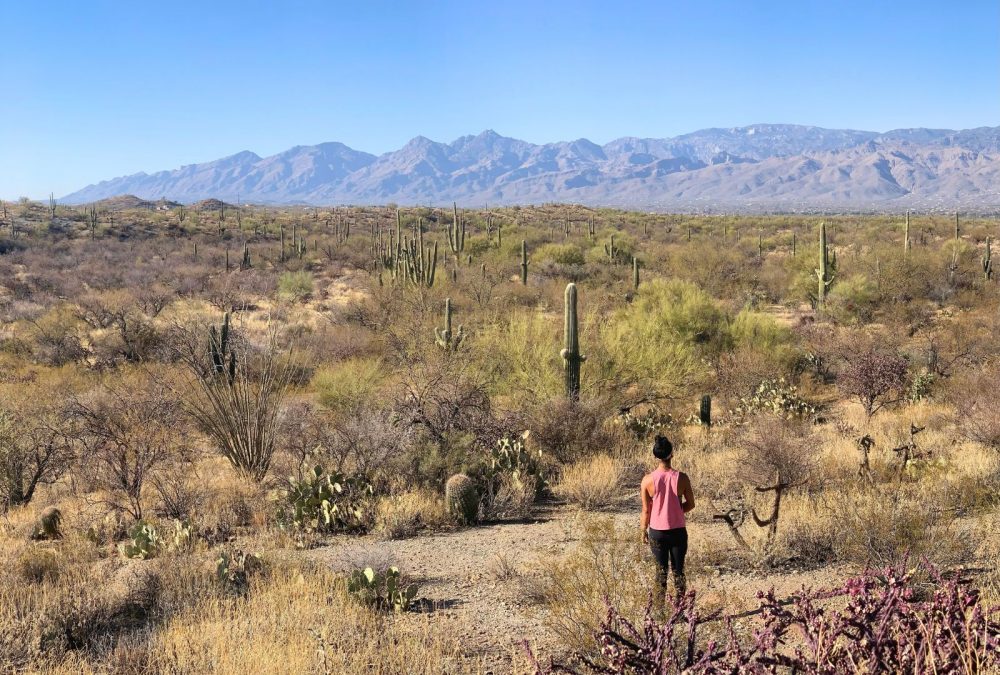
That means more time for hiking and gazing at views like this one:

This travel guide covers why visit Death Valley, the perfect detailed itinerary, and the most convenient lodging for your trip. Then, I’ll give you some ideas for road trips with Death Valley.
So, let’s get straight into how to best take advantage of your 1 day in Death Valley National Park!
Short on Time?
Here’s a quick mini guide for you to explore Death Valley in 1 day:
Night #1: sleep at Stovepipe Wells Village Hotel or camp at Stovepipe Wells campground
Visit landmarks in this order:
1. Mesquite Flat Sand Dunes
2. Visitor Center
3. Badwater Basin
4. Natural Bridge
5. Artists Drive
6. Desolation Canyon (Optional)
7. Golden Canyon
8. Zabriskie Point
Night #2: sleep at The Inn at Death Valley (or other options) or camp at Furnace Creek Campground
Is it worth visiting Death Valley?
Before traveling to Death Valley National Park, Lala saw pictures of the park and asked, “Do you think it’s worth going?” And people have asked me the same question since we visited.
Apparently the pictures just aren’t that good. Maybe they just don’t do it justice.
I’m SO thankful we ended up going.
I loved the park. Visiting Death Valley in 1 day is awesome… and very doable. But I think 3 days in Death Valley National Park would be the sweet spot to really get to know it, since it’s so big. It takes an hour and a half to drive through the park east to west, and it’s even longer north to south.
That’s part of its allure!
Death Valley is a valley so big it’s difficult to comprehend. You’ve got these weird, rugged mountains on the east. Their textures are amazing to gaze at – you can get lost looking at them like you would with a fire.
To the west are the huge mountains. They’re less textured but way taller. They rise to a maximum of 11,000 feet at Telescope Peak, which you can see across from Badwater Basin at 282 feet BELOW SEA LEVEL!
When we visited in mid-March, Telescope Peak still had snow on it. So, we were standing on the white salt flats, blinded by the sun and sweating profusely (again, in mid-March) while gazing up at the heavens where there was white snow and probably very cold temperatures. It’s quite the experience!
And then the drive through the valley is gorgeous. You have a little bit of everything. You can get up close to the mountains on both sides and explore canyons and dune fields. And at night, the hotels in the park light up with warm cozy light. Don’t even get me started on the stars.
It’s a surreal place you need to experience.
Exploring Death Valley in 1 Day
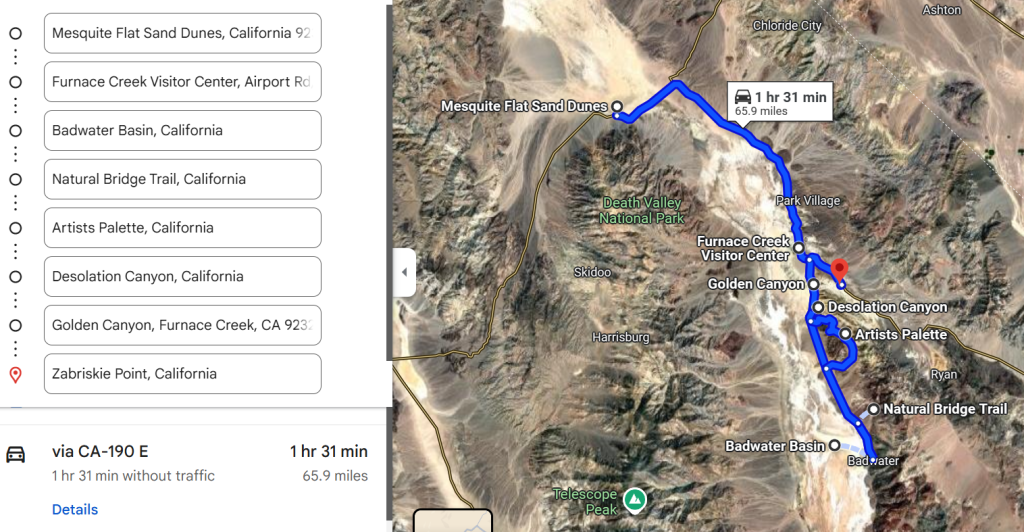
This itinerary goes from west to east, and you’ll be driving an hour and a half in total with lots of stops and hikes.
It’s most convenient from the west, like from Los Angeles to Death Valley. You’ll drive to where you’re sleeping, then continue the next day. Coming from Las Vegas to Death Valley, you’d have to drive over some of this route before doing it the next day.
Otherwise, visitors from Las Vegas could just do this itinerary backwards. Sunrise in Zabriskie Point and sunset at the Mesquite Flat Sand Dunes. BUT… Zabriskie Point is better for sunset.
So, I do recommend this order of landmarks. Let’s get to it!
1. Mesquite Flat Sand Dunes
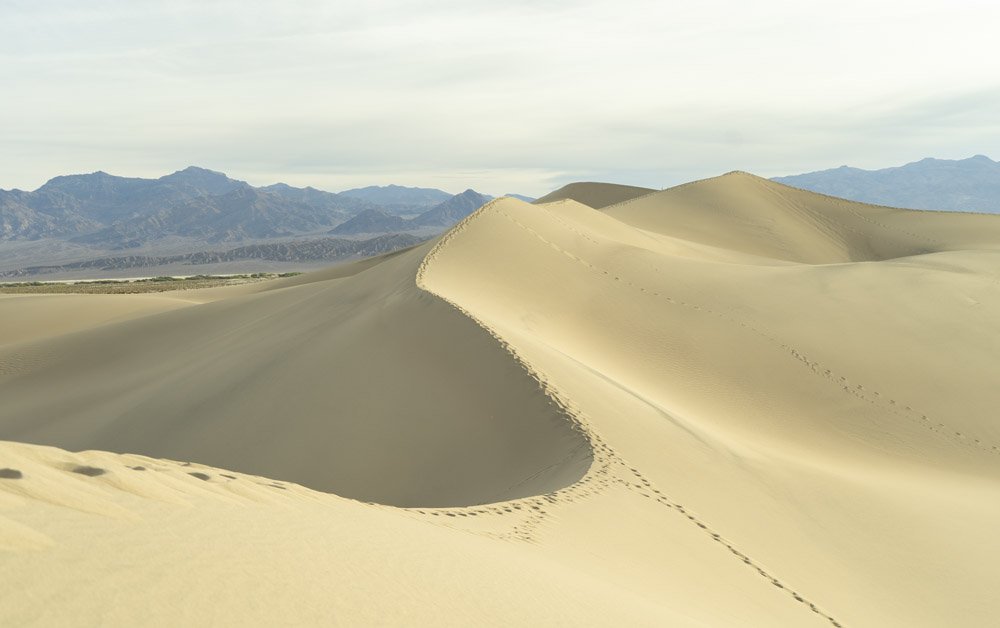
My favorite thing during my one day in Death Valley was watching the sunrise at the Mesquite Flat Sand Dunes.
Though Death Valley is a desert, only a tiny portion of it has dunes. That’s something I learned recently – that dune fields aren’t THE standard for deserts. They actually require specific conditions… and you get them at the Mesquite Flat Sand Dunes.
I recommend getting here 30 minutes before sunrise!
See, the dunes start out tiny, with lots of shrubs on them. It takes about 20 minutes of hiking into the Mesquite Flat Sand Dunes to get to where the dunes look impressive. It isn’t until then that they get tall AND you start seeing more of the distinct dune texture.
That texture is what looks so amazing and dramatic in the sunrise. So, it’s definitely worth getting there a little earlier – you get a lot out of those few minutes.
I say this from experience. I got there right at sunrise, but I wish I had already been in the middle of the dune field for the full experience.
2. Visitor Center
Next up is a 25-minute drive to the Visitor Center.
I always recommend going to the Visitor Center. I love learning about the park and how some of its formations were created. Then, when you’re seeing those formations, you know a little bit about them and it makes for a more complete experience. Maybe I’m just a nerd.
The park film at Death Valley is one of the best national park films I’ve watched. It’s actually narrated by Donald Sutherland, which I thought was amazing for a park film. If you’re wondering who that is… its President Snow from The Hunger Games.
After Lala got her park stamp, we made breakfast at the picnic tables by the Visitor Center.
3. Badwater Basin
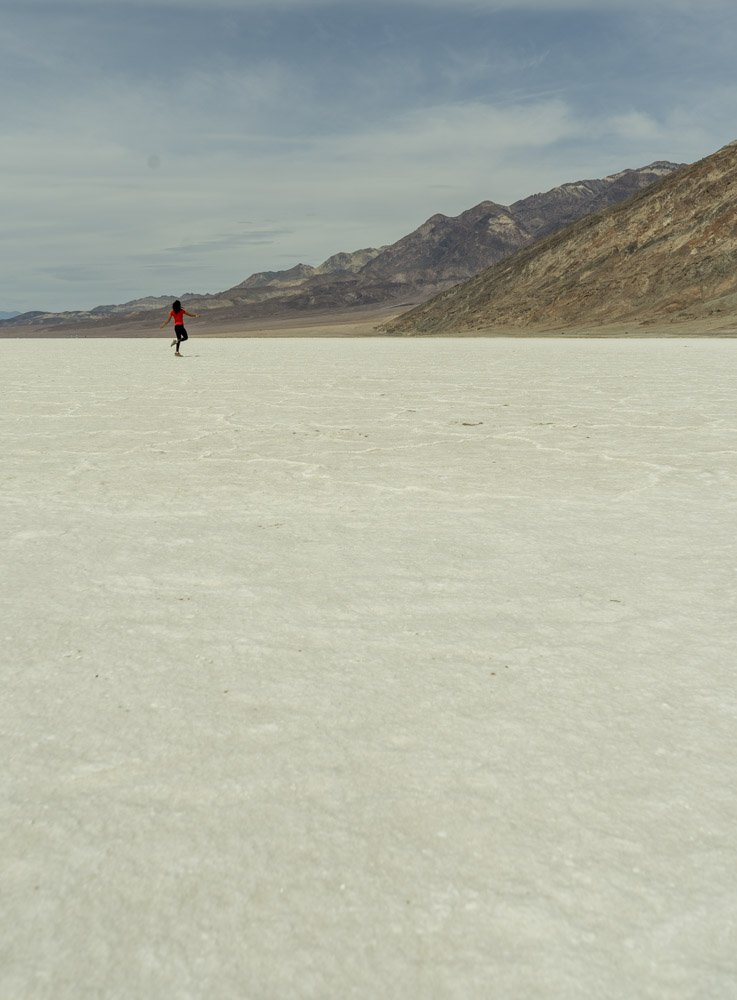

Another 23-minute drive gets you to the lowest point in North America: Badwater Basin.
Most of the other destinations on this Death Valley itinerary are on the road to Badwater Basin. You’ll pass them on your way there. What we did was get the drive out of the way first and then make all our stops on the way back.
But there’s another reason to do this – the HEAT.
Badwater Basin gets SO hot. We were there in mid-March and the sun was scorching hot. Oh, and I barely saw anything because the salt flat was reflecting the sun and I couldn’t open my eyes.
Don’t be like me. Take sunglasses.
Once you get to Badwater Basin, there’s a big parking lot. If you look at the mountains closest to you, there’s a small sign indicating where the sea level is. It’s pretty crazy!
The thing to see at Badwater Basin are the salt polygons on the ground. To see them, walk down to the salt flats. From there, it’s an easy walk for as long as you’d like, but the salt polygons look the best about 0.75 to 1 mile out into the salt flats.
Lala and I didn’t quite make it all the way because of how bad my eyes felt. However, we did make it far enough for the salt polygons to start looking more prominent. The biggest plus to this walk is that most people don’t walk very far, so you’ll be pretty much alone where it gets good.
Once you’re done, drive 4 minutes to the Natural Bridge trail.
4. Natural Bridge
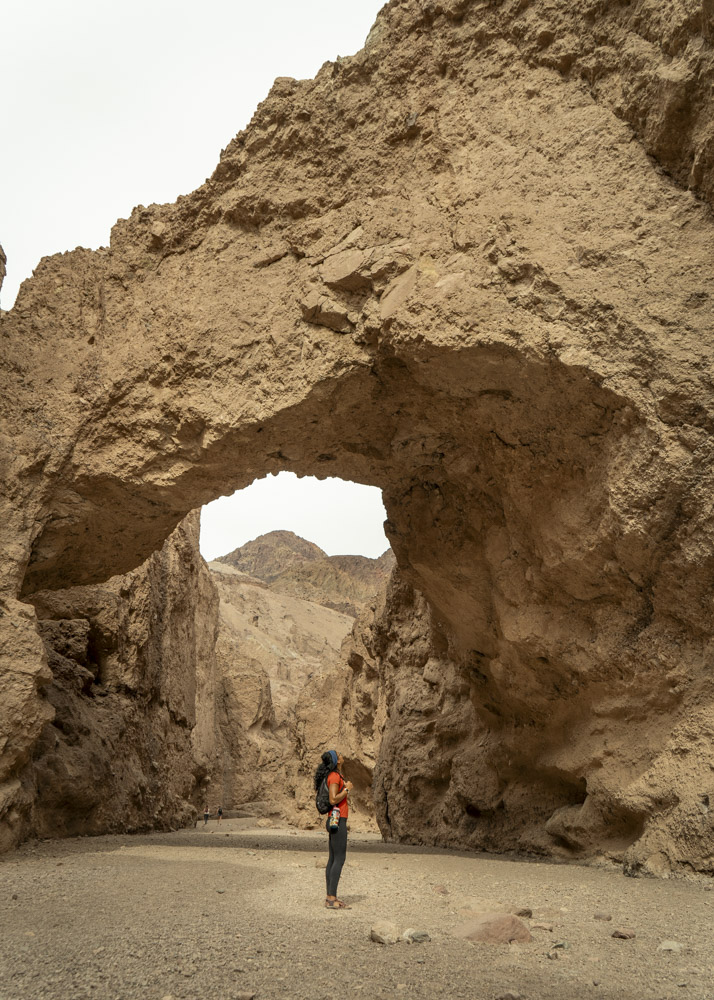
Apart from the sand dunes, this was my favorite hike. If you’re exploring Death Valley in 1 day, don’t skip this hike.
And do it right!
The Natural Bridge is a giant arch that crosses the entire wash. That’s something of a common theme in Death Valley – washes and flash floods. They’re what make the landscape so textured and rugged.
But don’t turn back there. The hike onward is SO beautiful.
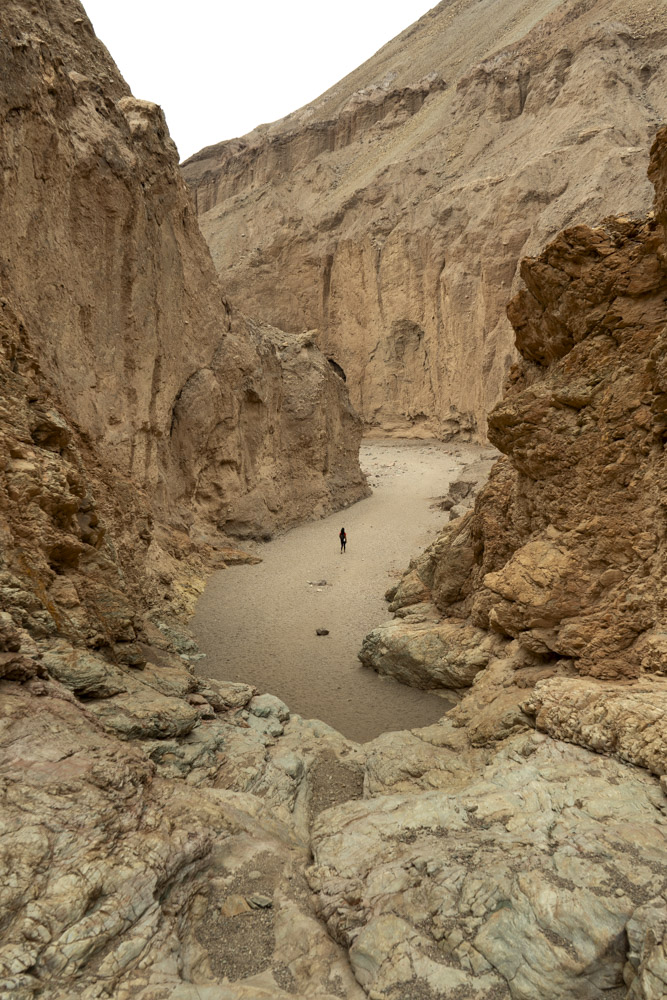
You get to a part of the wash that isn’t as sandy and you actually have to scramble over some steep rocks twice. It gets a lot narrower and the colors are amazing. Eventually, you get to a point where you just can’t keep going because there’s a wall of rock.
During a flash flood this must be an incredible waterfall! It would be amazing to see. But, if you were there during a flash flood… well, you would probably die.
Only then should you turn back, having enjoyed the Natural Bridge trail to the fullest. When I visited, only 2 other people made it to the end. The lack of crowds is also a huge plus for this part of the hike.
FYI, the drive to the parking lot is on an unpaved road, but any car should be able to make it.
5. Artists Drive
5 minutes away, there’s a scenic drive called Artists Drive.
Once you get to the intersection, turn right onto Artists Drive for a 9-mile scenic drive (it’s a one-way road). This drive is advertised as a way to see the beauty of Death Valley without all the walking.
But I think you do have to walk a bit to fully enjoy it.
There are two stops you should make on the way up. I’ve marked them both in my map of Death Valley attractions below. The first one is pretty soon after you’ve started the scenic drive. You can park on the side of the road and walk to an outlook to see some incredibly colorful and textured rock.
We stayed there a while thinking it was the main feature of the drive, Artists Palette, but it wasn’t!
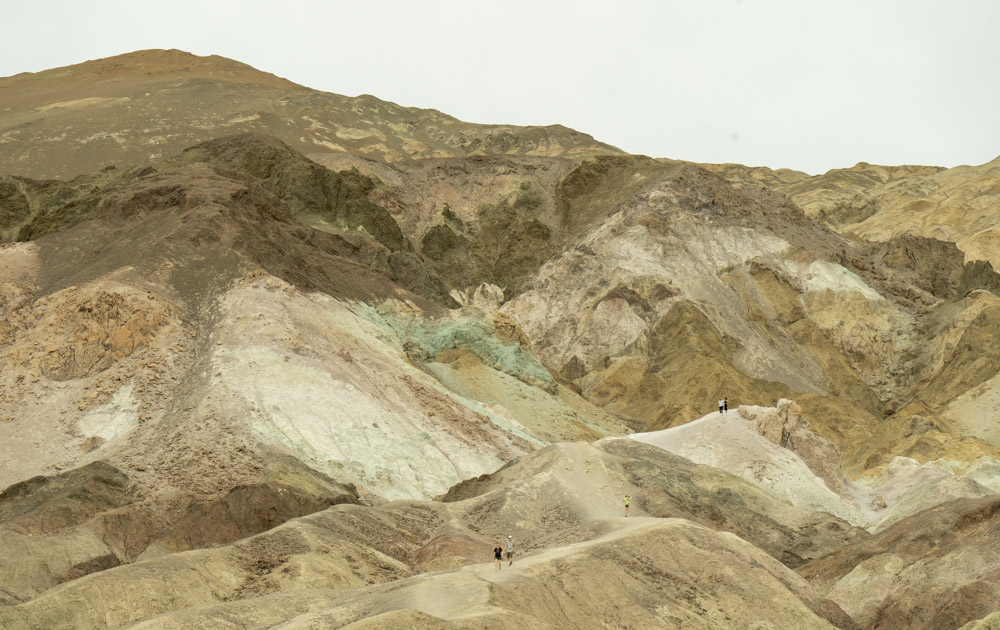
Artist Palette is further into the scenic drive, and you’ll notice when you get there. There’s a short road to the right of the main road where you can park. Walk around on the colorful rocks and get some spectacular pictures.
After enjoying that, finish up and drive 5 minutes to Desolation Canyon or 8 minutes to Golden Canyon.
6. Desolation Canyon
Lala and I didn’t actually do the hike in Desolation Canyon.
We were just too tired!
We definitely could have had the time to do it. It fits into this itinerary to explore Death Valley in 1 day. But we ended up spending a lot of time at Artists Palette just letting time pass because we needed the rest.
If you’re fit and feeling good at this point, definitely do the Desolation Canyon hike. It’s right on the way and well known because of the views and experience. I had heard of it before even researching Death Valley.
The hike is a 3.6-mile-long hike through a canyon. It’s wide at some points and narrow at others. You walk on sand sometimes and you walk on rock sometimes. All in all, it’s a great hike. Plus, since it’s an out-and-back hike, you can just turn back whenever you feel like it!
Golden Canyon is just 3 minutes away.
7. Golden Canyon
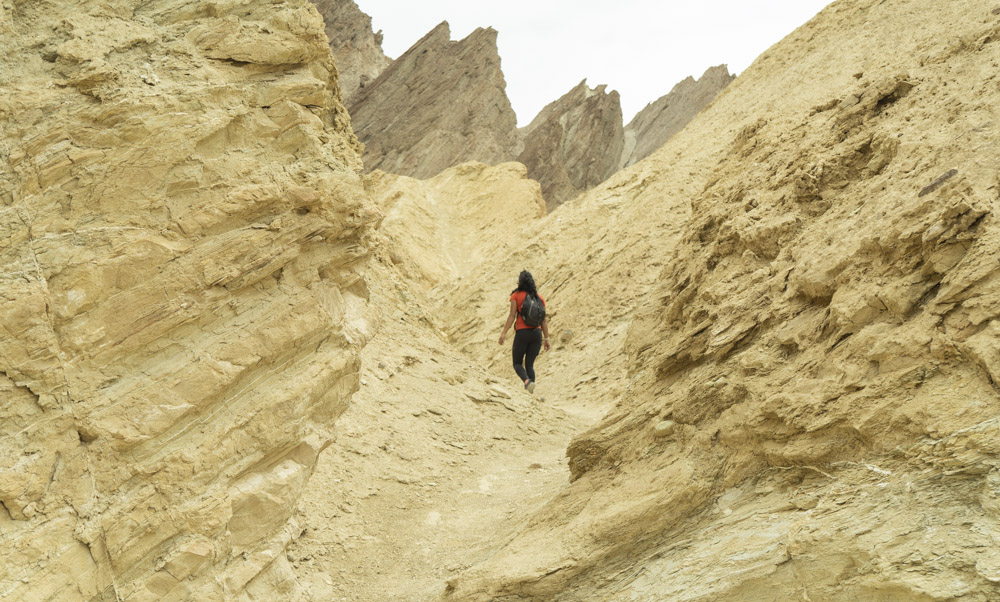
The hike through Golden Canyon is beautiful. It’s 1.5 miles to Red Cathedral, where the last 0.5 miles are very adventurous, with scrambling and crawling involved. Then it’s 1.5 miles back.
Since we were tired, we did the Golden Canyon hike a little differently. We started walking and didn’t make it very far. The canyon has a bunch of little washes going left and right into the hills.
We went right into one and ended up walking up some really steep hills, but not very far.
It was also adventurous, it was different and, most importantly for us, it wasn’t too long. Golden Canyon’s gorgeous yellow walls were spectacular.
8. Zabriskie Point
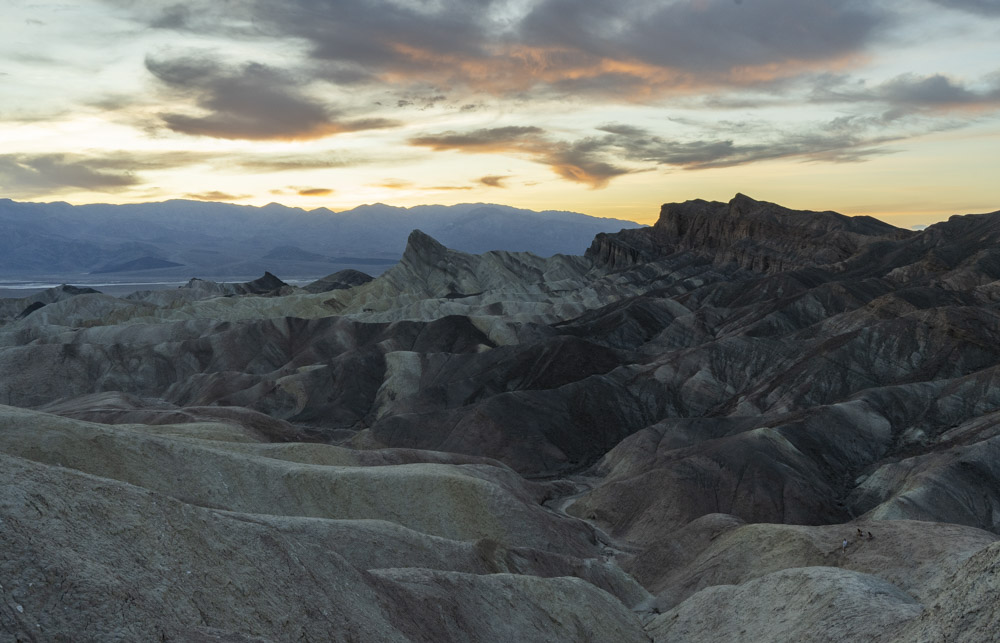
After a busy day, it’s probably close to sunset. The best place to watch the sunset in Death Valley National Park is Zabriskie Point.
Zabriskie Point is 10 minutes from Golden Canyon. It’s actually right behind the tall mountains you walk towards in Golden Canyon.
When you get there, park at the big lot and a short walk gets you to the Zabriskie Point outlook.
The view is so incredible. You have the rugged, flowy hills in front of you and Manly Beacon dominating the landscape. Further away, you can see the salt flats stretching onward and, finally, Telescope Peak and the towering mountain range.
You can walk around the badlands surrounding Zabriskie Point. But at this point, we were too tired for that. We just relaxed and enjoyed the sunset.
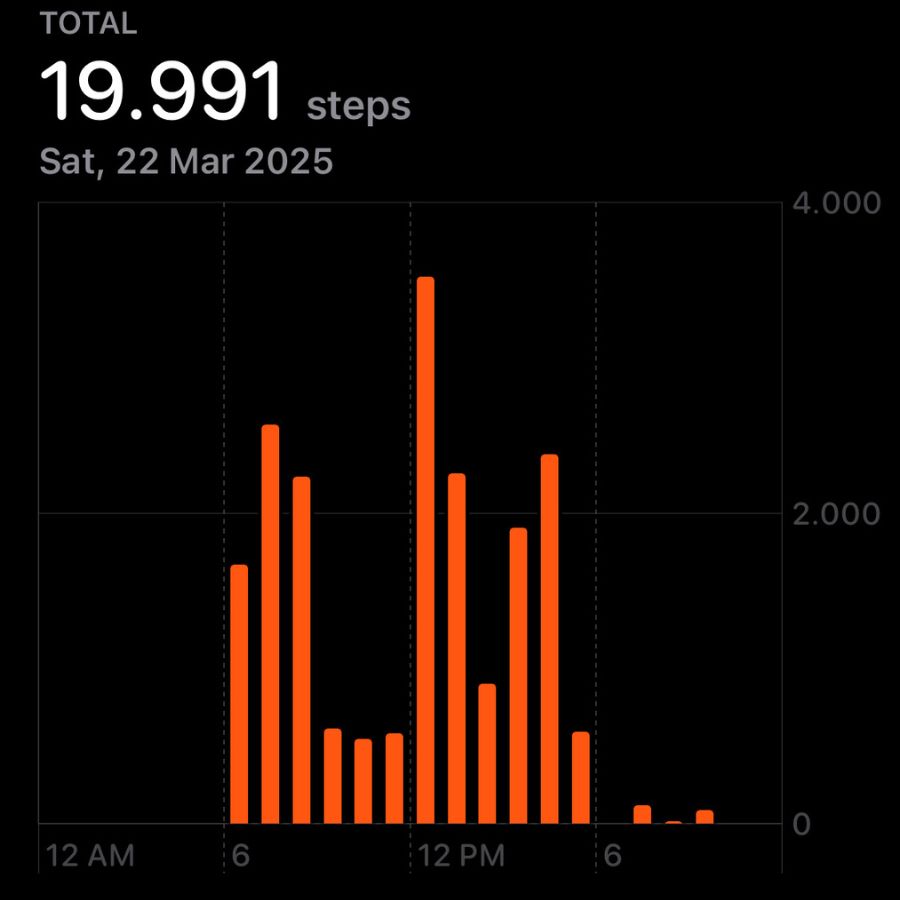
And just like that, you’ve seen the most famous landmarks in Death Valley in 1 day. It’s a BUSY day, but such a great one. I got 20,000 steps doing this itinerary!
Convenient Lodging to See Death Valley in 1 Day
Now that you know what to do in Death Valley National Park, let’s talk about the lodging.
To take advantage of your day (since the park is SO big), I recommend you arrive the day before and spend the night close to the Mesquite Flat Sand Dunes. Then, fully enjoy the day and spend one more night close to Zabriskie Point before leaving the park the next day.
This ensures the least amount of driving on the day of.
Fortunately, there are hotels, paid campgrounds and even free camping sites really close to the beginning and end of this itinerary. That is extremely convenient, which is a rare thing for some American national parks.
Here are all your options:
Paid and Free Camping in Death Valley
Death Valley is a rare national park in that there’s actually a lot of free camping available. It has two free developed campgrounds, 5 primitive campgrounds, and a bunch of BLM land for dispersed camping.
Unfortunately, the primitive campgrounds are SO hard to get to and the rest of the sites are way out of your way. But one free site is perfectly positioned for this itinerary: Emigrant Campground. The problem is, its first-come first-served and only has 10 sites. Good luck getting a spot!
Night #1:
- Free camping: Emigrant Campground – 14 minutes from Mesquite Flat Sand Dunes
- Paid camping: Stovepipe Wells Campground ($17 per night) – 5 minutes from sand dunes
Night #2:
- Free camping: The Pads – 17 minutes from Zabriskie Point
- Paid camping: Texas Springs Campground ($20 per night) – 8 minutes from Zabriskie Point
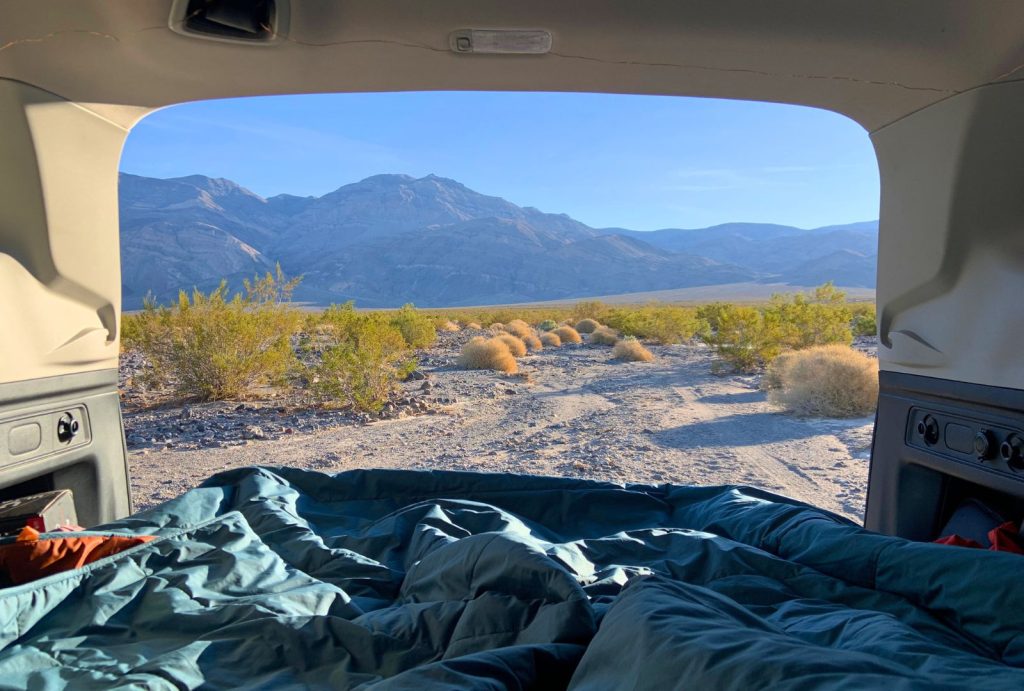
On our first night, we weren’t able to find a spot at Emigrant Campground and weren’t willing to pay for camping. But we saw people parked on the side of the road. So, we found a big pull-out close to a van and car camped there.
It’s technically not allowed, but nobody told us anything. Plus, we got there really late and were out before sunrise.
The next night, we found a GREAT spot as we drove west towards the Eastern Sierras.
If you’re planning any sort of trip in the Southwest, I actually made a free map with 70+ free car camping spots I found and vetted during my 2 years on the road. It’s my go-to resource whenever I’m planning where to sleep for the night.
👉 Grab the map for free below – I’ll email it to you right away!
Hotels in Death Valley
Death Valley has some really nice hotels. I was impressed.
They look so out of context because they’re surrounded by trees and look luxurious. That, in the middle of a rugged desert landscape, is so unexpected. I love it.
Night #1:
- Stovepipe Wells Village Hotel: 3 minutes from Mesquite Flat Sand Dunes
- Panamint Springs Resort: 38 minutes from sand dunes
Night #2:
- The Ranch at Death Valley: 8 minutes from Zabriskie Point
- The Inn at Death Valley: 6 minutes from Zabriskie Point
- Longstreet Hotel Casino & RV Resort: 34 minutes from Zabriskie Point
My Map of Death Valley Attractions
Use this map to get your bearings before you go. I’ve included all the stops on this itinerary to see Death Valley in 1 day. It also has the lodging options marked so that you can get a look at where they are.
To see what all these points are, tap on the button on the top left of the map.
With more than 1 Day in Death Valley…
Like I said before, there’s a lot to see in Death Valley. This guide just covers the best landmarks to see in Death Valley in 1 day.
I know I’ll be visiting again, and these are the activities I want to do and places I want to explore:
- Telescope Peak, the tallest mountain in Death Valley National Park. It’s a 12.2-mile hike with a staggering 3,200 feet of elevation gain.
- Dantes Ridge: The park ranger at the Visitor Center told me this spot was special. It’s an outlook where you can see the lowest point in Death Valley, Badwater Basin, and the tallest point, Telescope Peak. Great for sunset views and some tough hiking on the ridge.
- Ghost Towns: From researching online and then learning from the park film, Death Valley has several ghost towns. I’ll definitely be exploring some Ghost Towns, like Ballart, next time I go.
- Darwin Falls: This is one of the few year-round waterfalls in Death Valley National Park.
- Racetrack Playa: Death Valley has these huge rocks that move, and nobody knows how. They’re just there on the flats, with tracks behind them. There’s a theory on how they move, but nobody has actually seen them move. I really want to visit such an interesting place.
- Ubehebe Crater: A huge crater made by a volcanic explosion that you can walk into and around. I just love formations like this created by the violent forces of nature.
- Star Wars Tour: A lot of scenes for Star Wars Episode IV and IV were filmed in Death Valley National Park. There’s a guided driving audio tour of the locations, which you can do for free with the NPS app. I’ll be doing this next time, but I’ll be hiking to the locations too, not just driving.
Road Trips with Death Valley

Eastern Sierras road trip:
Being in Death Valley, you’re right by the Eastern Sierras, home to the tallest mountain in the lower 48. It’s such an imposing mountain range. The road trip includes Lone Pine, the Alabama Hills, Bishop and keeps going north to Tahoe. From there, you could keep going and get to know even more of California!
California road trip:
We visited Death Valley during our road trip in California. It started in with one day in Joshua Tree. Then we spent 2 days in San Diego and kept going through Los Angeles, Las Vegas, Death Valley, Alabama Hills, Bishop and Tahoe. Then, we continued to Yosemite, the San Francisco area and north on US Highway 1. Eventually, we drove northeast to Mount Shasta and road tripped through Northern California.
Las Vegas area:
Las Vegas has SO much to do. The city is obviously its own tourist attraction and worth spending lots of time getting to know. But then you can also visit Valley of Fire State Park and Red Rock Canyon and even Joshua Tree, in addition to Death Valley.
Frequently Asked Questions
The closest major airport to Death Valley is the Las Vegas international airport. It’s 119 miles, or 2 hours and 8 minutes from Death Valley National Park. This is by far the best way to travel to Death Valley.
Death Valley has an airport right behind the Visitor Center, but it’s for private planes only.
The best time to visit Death Valley is from Fall to Spring, which in Death Valley means late October to late April. Fall is still warm, but nice. Winter is colder and the snow on the peaks above makes it a whole different experience. And Spring is the best because the temperatures are mild and you might see blooming wildflowers in March and April.
Yes, there are gas stations in Death Valley, but they are expensive!!
When I visited in March 2025, the price per gallon was $5.81. For reference, I was finding gas in Las Vegas for $3.29 days earlier. So, fill up before getting to Death Valley!
You definitely can, but you won’t take advantage of your day the same way. For this itinerary, you’d have to get a REALLY early start and get back to Vegas late.
To really spend your time the best way, I recommend spending at least 1 night in Death Valley. You can arrive one afternoon, spend the night, do the itinerary and then drive back.
But if you absolutely have to make it a day trip to Death Valley from Vegas, follow this same schedule. Just skip the Mesquite Flat Sand Dunes, since it’s the furthest landmark from all the others.
I hope this guide has motivated you to travel to Death Valley. It’s one of the most underrated American national parks. If you have any questions about your trip to Death Valley, please comment below and I’ll be sure to answer!