The 5 Top Must-sees to Explore Yellowstone in One Day
Yellowstone National Park is the most beautiful national park I’ve visited. It was also THE first to be named a national park, and you can tell. Its infrastructure is incredible. You can easily explore Yellowstone in one day without too much work. The most amazing parts of the park are accessible driving or with short hikes.
All in all, it’s a very drivable park.
That being said, Yellowstone National Park is best enjoyed getting out into the backcountry. However, not everyone has the experience or time for that. That was definitely my case when I visited Yellowstone.
But the one day I spent in Yellowstone was spectacular. I was just blown away by its beauty and wildness.
This national park guide covers the perfect itinerary to see everything you need to see in Yellowstone in one day. You’ll love it if you want to get the best value from your time there and want to hike, but not too much.
I’ll go into all the stops and how to best take advantage of your time, with a map for reference.
Let’s get into it!

What Makes Yellowstone Special?
There are SO many things that make Yellowstone National Park a special place.
- It was the very first national park, and rightfully so.
- The abundance of wildlife here is hard to believe. You can see bears, bison, elk, etc. Funny story… at Grand Teton National Park, a park ranger told us we didn’t really need bear spray. When we told him we were headed to Yellowstone next he said the exact opposite – “You definitely need bear spray.” There are better odds of you seeing a bear in Yellowstone, and not just any bear – a grizzly.
- Yellowstone National Park has everything you’d expect from a super wild place. It has endless green forests, canyons, waterfalls, wildlife, lakes, you name it! But then what makes it stand out is the geysers. You can find deep pools of super-heated water all over the park. They’re extremely colorful because of the minerals in the water and SO clear. They exist because Yellowstone is essentially on top of a super-volcano. The water in those pools gets heated up by magma under the earth’s surface. It’s such a weird thing to see and what makes the park so, so special.
- Like I said before, it’s very drivable and has lots of short hikes to iconic places and views. It’s really accessible. But then it’s also one of the best national parks for multi-day camping trips in the backcountry. So you can see Yellowstone in one day or explore it for weeks! It has something for everybody.
How to get to Yellowstone National Park
Yellowstone is so big that it has 5 entrances:
- The South Entrance, from Grand Teton National Park
- The West Entrance, from Idaho
- The North Entrance, from Montana
- The Northeast Entrance, from Montana/northern Wyoming
- The East Entrance, from Wyoming
It is absolutely necessary to have a car to visit Yellowstone National Park. That means it’s best to visit as part of a road trip (scroll down for a bunch of road trip ideas with Yellowstone) or fly to the nearest airport.
The nearest airport and most convenient way to explore Yellowstone in one day is to fly to the Jackson Hole Airport. From there, you can rent a car. This forces you to drive through Grand Teton National Park (oh, well) to get through the south entrance and to the Old Faithful Visitor Center.
The south entrance really is the most scenic. I mean, you drive right next to the Grand Tetons. It’s the best way into Yellowstone and gives you the best bang for your buck.
I entered the park from the south. Then, I exited the park through Lamar Valley, at the Northeast entrance. For this Yellowstone itinerary, it doesn’t matter where you enter the park. Just know, it starts at the Old Faithful Visitor Education Center and ends in Lamar Valley.
Travel Tip
Use Discover Cars to rent rental cars for your road trip, choose full coverage insurance, and opt for trusted companies like Hertz and Sixt. Book your car with Discover Cars here.
How to Get to Know Yellowstone in One Day
*Map may not show the best directions during winter, spring and fall due to road closures! But the stops are in order and best visited during the summer months.
1. Visitor Center
I always recommend going to the Visitor Center at national parks. But this Visitor Center is even more special. As in all of them, you learn about the park and how it came to be. Then, you get to go see the things you learned about while you explore.
I love that… but I’m also a nature nerd.
The reason this Visitor Center is so great is that it’s right next to Yellowstone National Park’s two most iconic landmarks: Old Faithful and Upper Geyser Basin.
- Old Faithful: though it’s not the most powerful geyser in Yellowstone, it is the most famous. Old Faithful is practically THE logo of American national parks. It’s what I think of when I think about Yellowstone. Well, that and bears.
- Upper Geyser Basin: here, you can explore the largest concentration of geysers in the world. The trail to see them is easy to walk and the boiling pools are gorgeous.
In other words, this Yellowstone National Park itinerary starts off STRONG.
While you’re still at the Visitor Center, watch the park film (amazing), get your park stamp, and get info about when Old Faithful is going to blow!
2. Watch Old Faithful Erupt
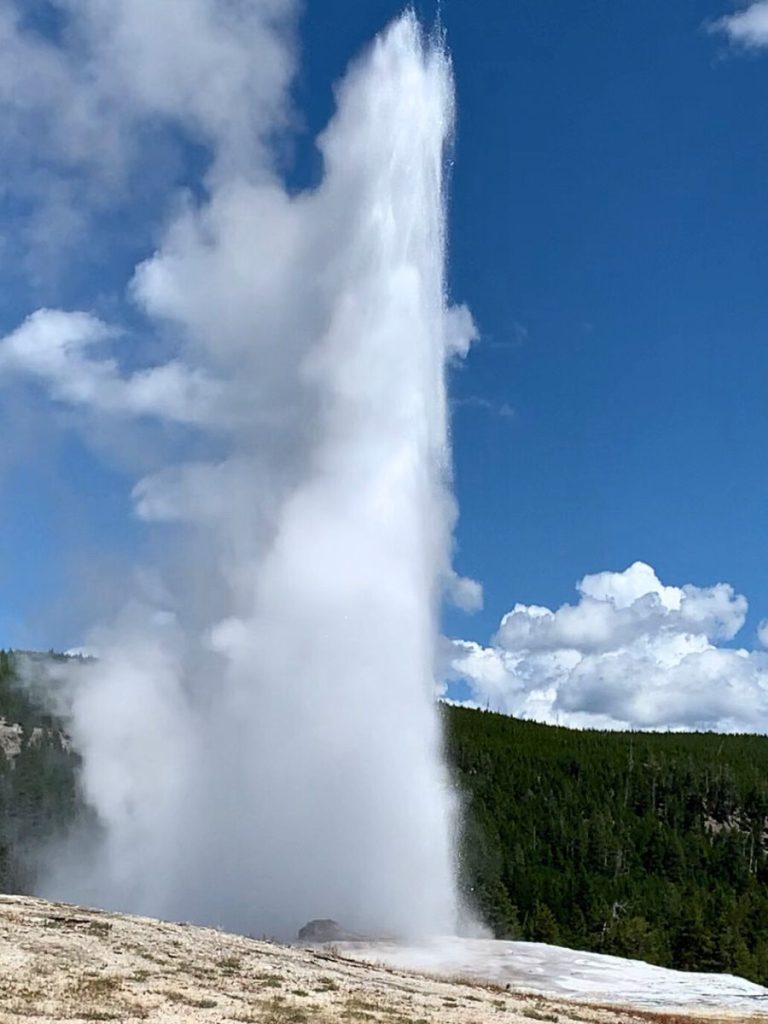
My favorite thing during my one day in Yellowstone was watch Old Faithful erupt.
This is coming from a guy who loves being active in nature. I always prefer a hike to a view over an easy overlook.
But standing there in the crowd and watching the violent forces of nature at play was astounding. I loved watching it. The waiting, the expectation, the slow start and people’s gasps, and then the water erupting over 100 feet into the air. It was awesome.
This is the most iconic thing to do in Yellowstone. You HAVE to experience it at least once.
That being said, you might have to wait up to 90 minutes depending on when you get there. If you have to wait, go ahead and do the next item on the itinerary. It’s an amazing hike to see a TON of geysers. That’s what I did!
You can watch the eruption from the Old Faithful Viewing Area or go on a 0.75-mile walk to Observation Point.
How to Time Old Faithful
There are several ways to find out when Old Faithful is going to erupt.
The easiest way is to join the crowd. If you see a big crowd by Old Faithful, it means it’s going to erupt soon.
Other than that, you can find out on signs at the Visitor Center. They make it very clear, since it’s the park’s most well-known destination. You can also talk to a park ranger. They can let you know the prediction and help you out with information about your trip.
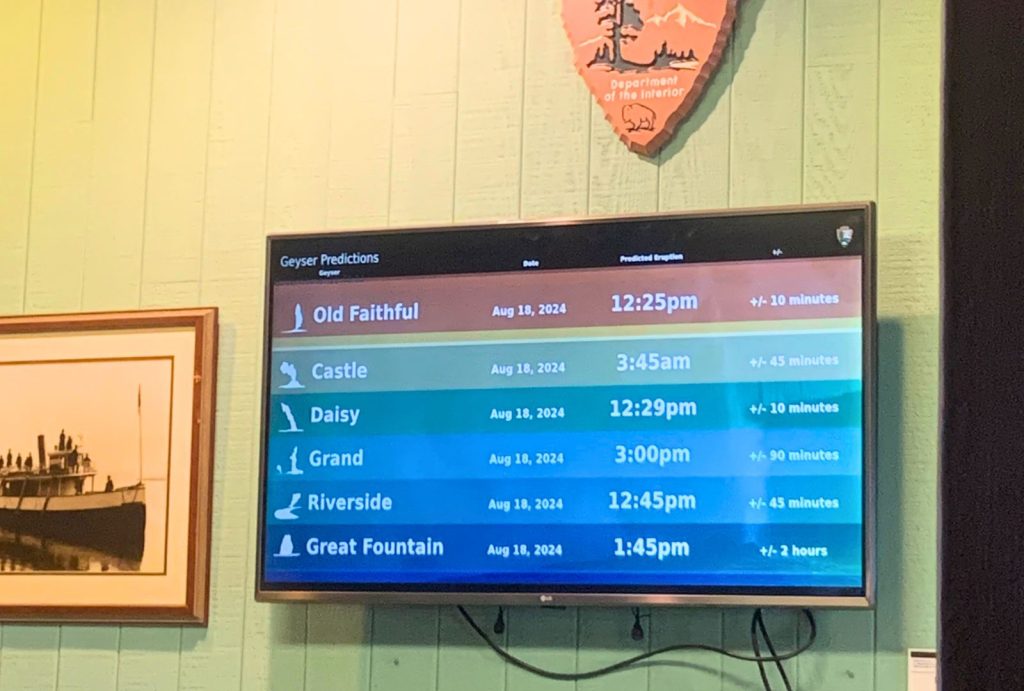
You can also plan ahead and know the predictions before your visit to Yellowstone National Park. You can find out on the NPS app, call the national park to hear a recorded message on current predictions, or check out the Geyser Times website (which is pretty hard to understand).
3. Upper Geyser Basin Trail
This easy trail on paved surfaces and boardwalks is absolutely amazing.
This trail is worth it even if you already saw Old Faithful erupt because it holds the world’s highest concentration of geysers. The Upper Geyser Basin has over 400 geysers. You don’t see all of them on the trail, but, believe me, you’ll see enough.
They’re all different shapes, sizes and colors. Some blow every once in a while, like Old Faithful, while others are always bubbling.
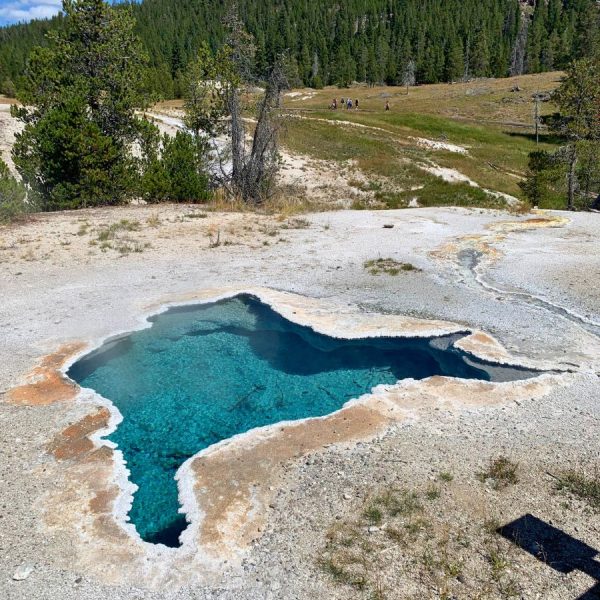
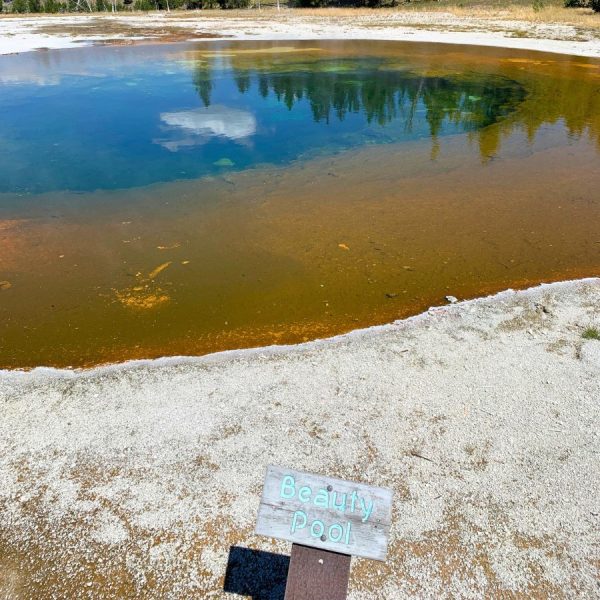
The best thing about the Upper Geyser Basin Trail is you can choose how long to hike. If you go all the way to the end, it’s a 3-mile loop. You can make it longer (a 5-mile loop) if you walk to Biscuit Basin, another area with lots of geysers.
But I didn’t walk the entire loop. I walked until I got tired and took one of the many ways around towards Old Faithful. It’s a great introduction to the bunches of geysers you’ll be seeing.
This trail is the best way to use your time to get to know Yellowstone in one day. You get to see the most geysers with the least amount of effort.
My favorite geysers on this hike were Castle Geyser, which never stopped bubbling, Wave Spring, Chromatic Geyser, Bottomless Pit, and Belgian Pool.
Should you time your hike?
At the Visitor Center, you’ll be able to see predictions for when some of the minor geysers on the trail will explode.
But my recommendation is not to worry too much about these. There’s so many, you’re likely to see a lot of action without trying to time your hike perfectly.
What I did when I visited Yellowstone was take a quick look at the predictions for geysers on the trail. Keeping that in mind, Lala and I tried to get to certain geysers in time to see them go active. We ended up missing almost all of them, but we still saw SO much. We’d stop to watch a random geyser bubble and burst, only to realize we had missed another.
To sum it up, hike without worrying about timing it. And I promise you’ll be impressed no matter what.
Why I Didn’t Want to Hike Much
I had just come from Grand Teton National Park, which is my favorite national park.
It was a very active few days in the mountains. I was tired.
To make it worse, I had climbed up the Middle Teton the day before traveling to Yellowstone. That’s a 13-hour hike with 6,500 feet of elevation gain. So… yeah. I was decidedly not walking much AT ALL the next day.
4. Norris Geyser Basin
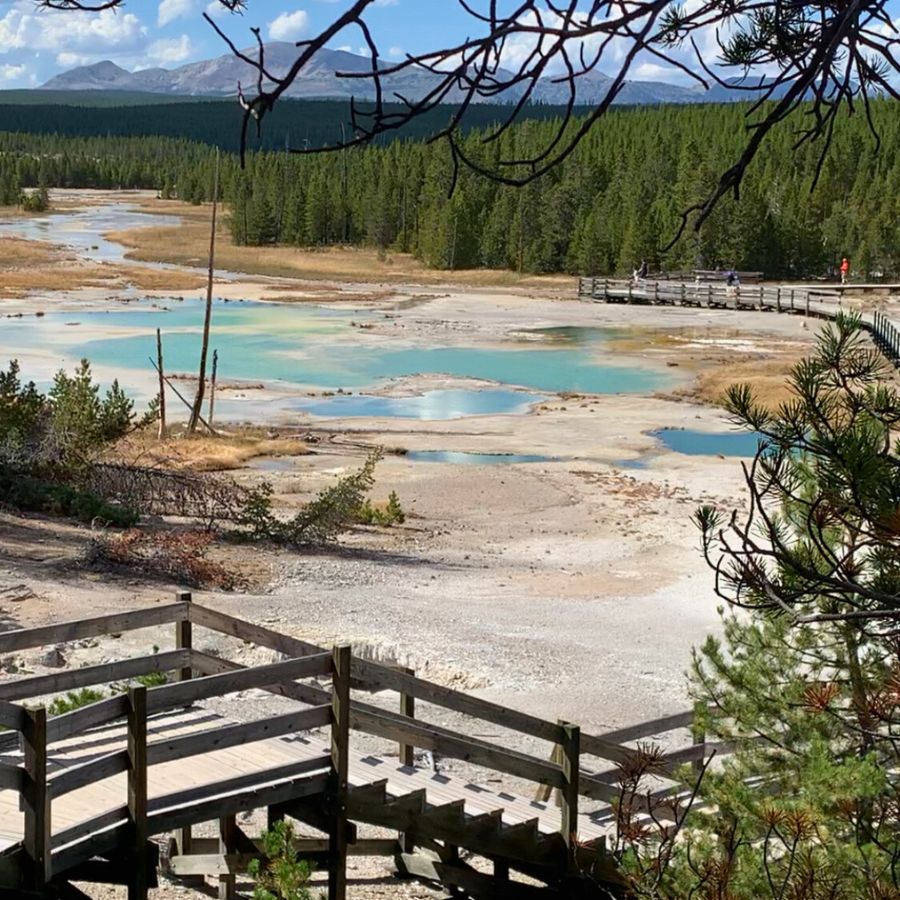
The next stop on my trip to Yellowstone was Norris Geyser Basin because it’s the most dynamic geyser basin in the park. Something’s always going on here.
It’s also home to the world’s tallest geyser: Steamboat Geyser, which can push water up to 300-400 feet in the air. But it’s nearly impossible to predict when it’s going to erupt. If you do, I envy you!
The difference between Upper Geyser Basin and Norris Geyser Basin is that Norris is more densely beautiful. Now, individual geysers anywhere are gorgeous. But the walk in Norris Geyser Basin starts from a hill above the geysers. This means you get a sweeping view of the geysers in all their colorful beauty.
Start at the Norris Geyser Basin Museum for a quick learning experience. From there, you can do two loops.
- The loop to the right goes through Porcelain Basin. It’s a ¾-mile loop on the ground and boardwalks. Other than the initial hill, it’s mostly flat. This is where you can see lots of geysers in a single panoramic view because there aren’t many trees.
- The loop to the left goes through Back Basin. It’s a 1.5-mile trail, also on bare ground and boardwalks. But this trail goes through the woods, so you walk from one feature to another. This is where you can find Steamboat Geyser.
The 143 parking spots here can fill up quickly, especially in the summer. When I visited, I had to park in the overflow parking on the main road and hike a short way to the museum (which is the trailhead).
It’s even possible that it’ll get so full that there’s no overflow parking!
5. Grand Canyon of the Yellowstone
Next on the itinerary to see Yellowstone in one day is none other than the Grand Canyon of the Yellowstone.
It’s a deep canyon cut into the earth by the Yellowstone River, and it has two scenic drives with lots of short hikes to gorgeous outlooks.
To get there, go straight on Norris Canyon Road as you exit Norris Geyser Basin. This road crosses Yellowstone west to east right in the middle of the park, ending at Canyon Junction. Then turn right for a 5-minute drive to the Grand Canyon of the Yellowstone.
I recommend doing the south rim scenic drive first and then the north rim scenic drive. The north-rim drive ends back at Canyon Junction, and you can be on your way.
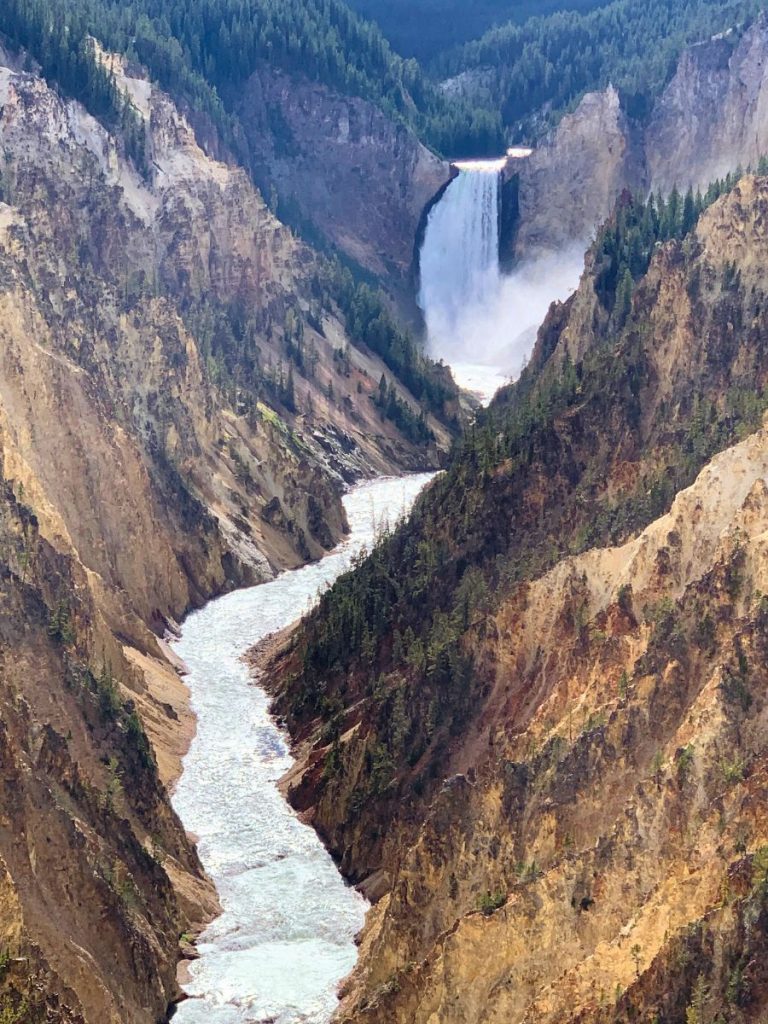

South Rim Scenic Drive (best view)
This is a short scenic drive with two incredible viewpoints. Drive all the way to the end of the south rim to Artist Point for the best view in Yellowstone.
I stayed there a while, gazing at the view of Lower Falls. You can also see puffs of steam in the canyon, where there are thermal features and geysers too!
Then, on your way back, you can stop at the Upper Falls View. It’s amazing too, but not quite like Lower Falls.
North Rim Scenic Drive
When you get back to the main road, turn right and follow signs to the north rim. You’ll turn right onto that road (it’s a one-way road) to all the outlooks and, eventually, back to Canyon Junction.
The scenic drive has 4 viewpoints, and they’re all worth it. I stopped at all 4, and each one has a different impressive view.
The first one is right at the start of the scenic drive – Brink of the Lower Falls. Take some steep switchbacks to the edge of the canyon. The other viewpoints are Lookout Point, Grand View and Inspiration Point. The road to Inspiration Point is a spur road off of North Rim Drive.
They all involve short hikes, but they’re pretty steep!
Back at Canyon Junction, there’s a restaurant and general store. You might want to stock up for the drive ahead into the Serengeti of America.
6. Lamar Valley
Lamar Valley may be the best place in America to watch wildlife.
It IS called the Serengeti of America. You can see elk, bison, deer, and pronghorn. The best part is you don’t need a telescope or telephoto lens. You’ll see wildlife so close that you’re likely to end up in traffic as herds cross the road.
I’ll be honest, I was a little disappointed when we first started the drive. People were standing by the side of the road looking far off through their telescopes. The landscape is gorgeous, but I couldn’t see any of the wildlife they were talking about.
But we drove further into Lamar Valley and that’s when it got good. We kept passing herd after herd of bison. They would cross the road, forcing everyone to stop for their safety. The bison fought right next to us and puffed steam from their nostrils an arm’s length from the car!
They also did this thing where they’d roll around in the dirt. To see such a massive animal moving so lithely was breathtaking. It was just an amazing experience!
But don’t touch or feed the bison. If they choose to get up close to your car, just observe and enjoy the experience.
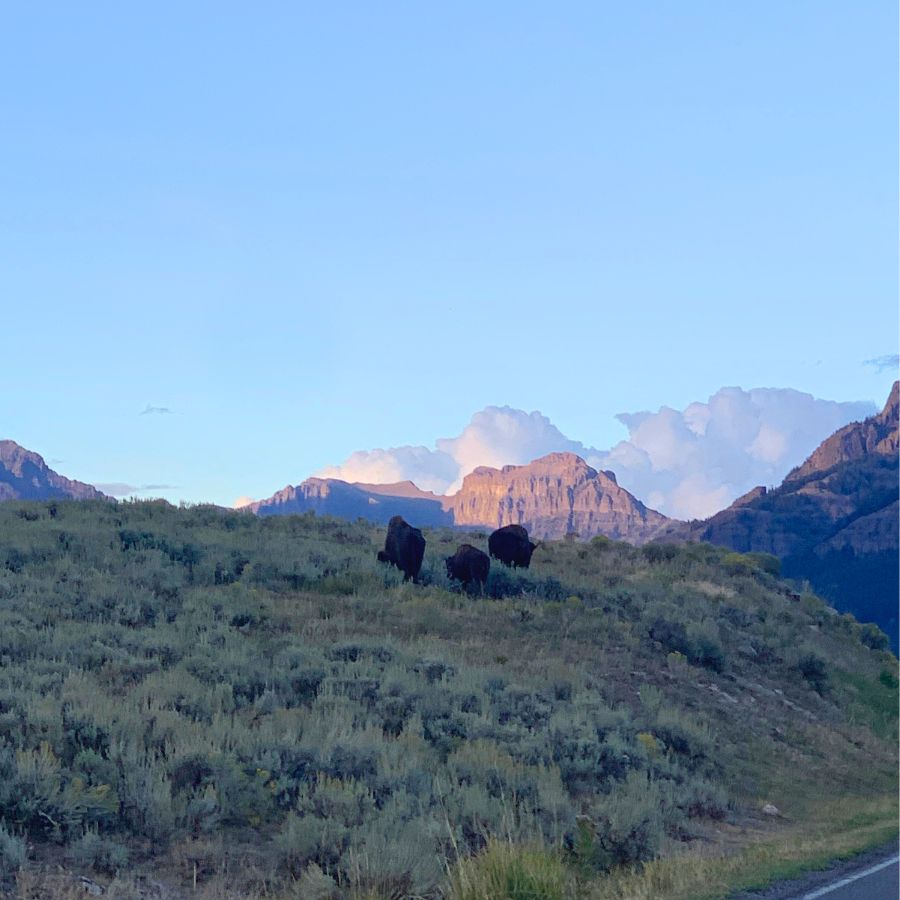
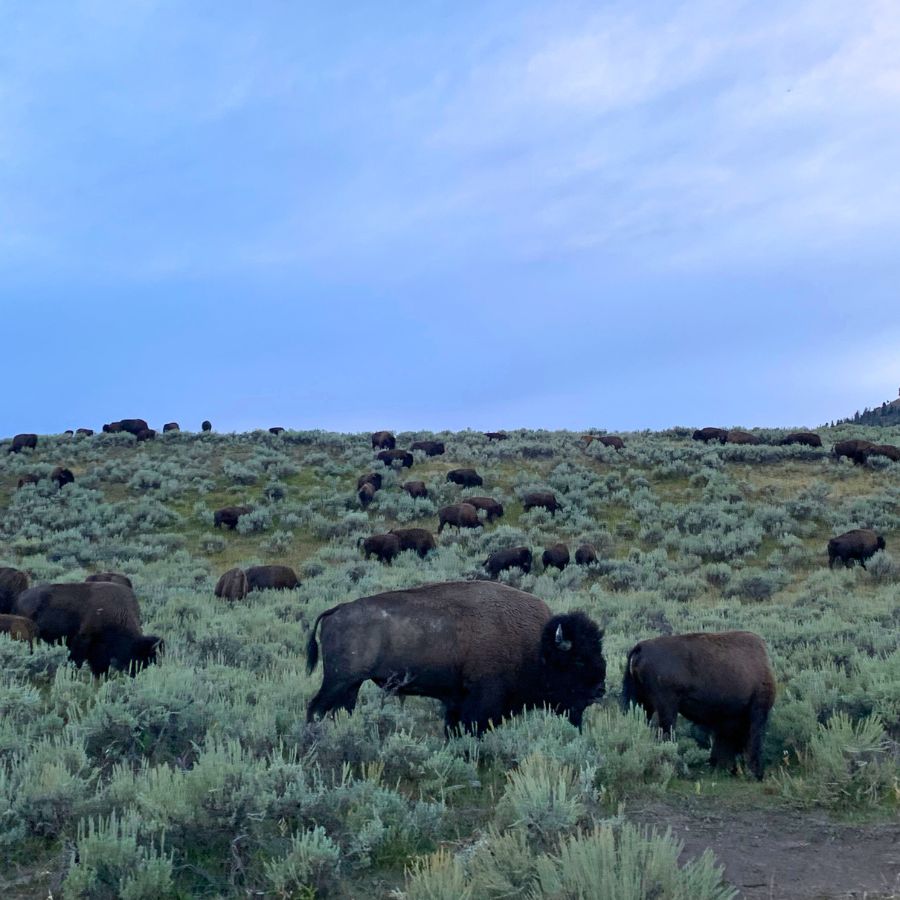
How to get to Lamar Valley
To get to Lamar Valley, head north from Canyon Junction. Turn right at Tower Junction to start driving east. This is where Lamar Valley begins, and you can drive all the way to the Northeast Entrance to Yellowstone National Park.
I exited the park there to continue driving into northern Wyoming. But if you aren’t headed that way, you don’t have to get all the way to the entrance. Turn back once you’re satisfied.
The drive from Canyon Junction to Lamar Valley is about an hour long – double if you’re driving back. So, keep that in mind.
Lamar Valley is out of the way, but I think it’s a must-see if you’re trying to explore Yellowstone in one day.
Try to get to Lamar Valley during the sunset! It was surreal!
And just like that, you’ve seen everything Yellowstone has to offer in 1 day. You’ve seen two incredible geyser basins, not to mention getting to watch Old Faithful erupt. You’ve got to know a majestic, deep canyon with two immense waterfalls. And you got close up with one of the things that makes Yellowstone SO special: wildlife.
That, I must day, is a successful day in anyone’s book.
It’s exactly how I spent my 1 day in Yellowstone National Park.
Free Camping near Yellowstone
The free camping near Yellowstone isn’t very convenient. It’s all outside the park. And, since the park is so big, this means the free camping can be kind of far from things. But if you’re like me, you tend to prefer “free” over “convenient.” So, here’s are a bunch of free camping sites near Yellowstone.
- South: This is where we slept before doing this Yellowstone itinerary, since we were driving from Grant Teton National Park. We slept at the Grassy Lake Road Campsites. It isn’t very big, but we found space and it was beautiful! Then, we drove an hour and a half to the Old Faithful Visitor Center.
- West: There’s a spot we found on Campendium just south of the town of West Yellowstone.
- North: Timber Camp Campground has 3 sites, but it’s so out of the way, it might be empty. If not, I’m sure there are more free sites in the area!
- East: We slept pretty far from the park after our one day in Yellowstone, beyond Cody, Wyoming. We were driving to Ten Sleep the next day. But there’s free camping close to Buffalo Bill State Park too, and probably some even closer to the park.
I created a custom Google Map with all the free camping I found near Yellowstone. It’s the perfect way of visualizing the distances between everything for when you plan your trip! When you click the link, tap the icon on the top left to see a menu with all the spots.
I also made a map with ALL the places I’ve researched for car camping for free all over the USA!
For more spots, use the apps Campendium and iOverlander to browse all the free camping near Yellowstone and read reviews. That’s what we use!
Lodging in Yellowstone National Park
Yellowstone has 9 different hotels and inns throughout the park. But even though that’s 2,000 rooms, it isn’t nearly enough. You have to make your reservations way ahead of time because the rooms fill up quickly.
The most convenient lodging for this Yellowstone itinerary is the Old Faithful Inn. If you want lodging up close to Lamar Valley, there’s actually a cool, super tiny town called Silver Gate with several options.
In terms of campgrounds, there are 10 dispersed throughout the park. They’re open seasonally and cost $20 – $39 a night. There’s one RV park that costs $99 a night.
Here’s the Yellowstone National Park website with all the information on campgrounds and their locations.
Road Trips with Yellowstone National Park
Wyoming road trip: This road trip includes two of the best American national parks – Yellowstone and Grand Teton National Park. After visiting those two parks, it goes on to the Wind River Range, which rivals Torres del Pain (Argentina). You also go through the awesome town of Lander and Ten Sleep Canyon.
National Park road trip: This is one of the best road trips in the USA, and you can extend it into Canada. It starts in Grand Teton National Park and goes on to Yellowstone and Glacier National Park. That by itself is an awesome road trip, but you can make it even better. Cross the border and drive from Glacier to Banff and Jasper National Parks in Canada. Congratulations, you just saw some of the world’s best views in one road trip.
Frequently Asked Questions
The distance from Salt Lake City to Yellowstone National Park is 322 miles (4 and a half hours). From Seattle to Yellowstone National Park, it’s 740 miles, or an 11 hour and 15 minute drive.
Driving from Denver to Yellowstone, it’s 639 miles, or a 10 hour and 20 minute drive. And if you were to travel from Las Vegas to Yellowstone National Park, it’s a 10 hour and 11 minute drive (740 miles).
Yes, the airport closest to Yellowstone National Park is the Jackson Hole Airport, 138 miles from the park.
Yes, but in a very limited way. They aren’t allowed on any trails. They can pretty much only be in developed areas and never more than 100 feet away from the closest road, campground or parking lot. Check out the rules here.
Most of the hotels in the park are pet-friendly!
Final Thoughts
I hope this travel guide to Yellowstone National Park has helped plan your trip! I’m passionate about making it easier for my readers to get motivate to get out there.
If you have any questions about exploring Yellowstone in one day or about the park in general, please comment below and I’ll be sure to answer!
*This blog post contains affiliate links. This means if you click on a link and go on to buy the product I recommend, I will get a small commission, but you will not be charged any more – thanks in advance!